Guide
What a Commercial Property Inspection Covers in Central Arkansas
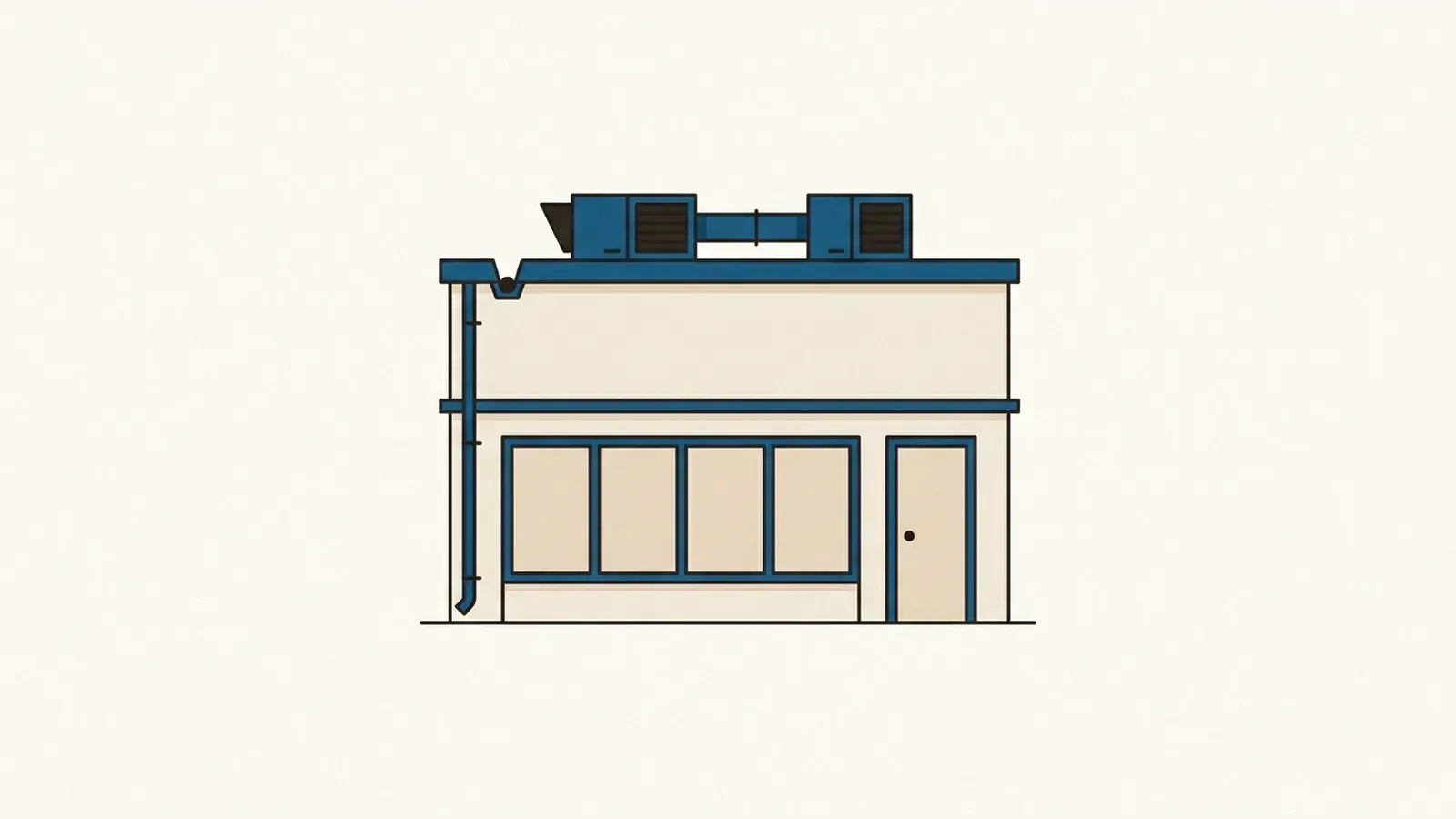
Most inspection questions are about houses. Commercial buildings come up less often. When they do, it's usually the same three questions: what does a commercial inspection cover, why is there no price list, and how long does the report take.
Geography first. We work out of Conway and cover 15 Central Arkansas counties and 143 cities and towns. If your building sits outside those counties, call before you plan around us. Properties beyond a 2-hour drive are welcome with a custom quote.
What Is a Commercial Property Inspection?
A commercial property inspection is a visual, non-invasive review of a building's observed condition on the day of the inspection. We document it with photos. An owner, buyer or investor can then plan and negotiate from facts instead of guesses.
We inspect commercial property across Conway and Central Arkansas. Offices, retail, warehouses and multi-unit buildings are all welcome. Every inspection is done by a licensed Arkansas home inspector. David flags safety, maintenance and code-related risks early and photographs them, so you've got numbers to negotiate and plan with. The scope is on the commercial inspection page.
An inspection reports the observed condition of the property on the day of the inspection. It isn't a warranty. It isn't a guarantee, and it isn't a grade. You get the facts in plain language, and you decide.
How Is a Commercial Inspection Different From a Home Inspection?
There's more building, more equipment, far more variation. So we set the scope before the visit instead of assuming it.
A single-family house is a fairly predictable object. One roof covering, one or two heating and cooling systems, one electrical service, one set of plumbing runs. An inspector can walk up to almost any house in Faulkner County and know roughly what he'll find and how long it'll take.
A commercial building isn't predictable that way. A 4,000 square foot retail suite in a strip center, a metal warehouse with a dock door, and a two-story office with three tenant spaces are three different jobs. Different roofs, different mechanical layouts, different electrical demands, different tenant setups that decide who has the keys to what. That's why the conversation starts with questions about the building instead of a number.
| Residential inspection | Commercial inspection | |
|---|---|---|
| Typical property | Single-family house, townhome, condo | Office, retail suite, warehouse, multi-unit building |
| Roof | Usually a sloped shingle roof | Often a low-slope membrane or built-up assembly with drains, curbs, and parapets |
| Mechanical | One or two systems for the whole house | Several units, often on the roof, sometimes split between tenant spaces |
| Electrical | A single service and panel | A larger service with subpanels and equipment loads spread through the building |
| Site | Yard, driveway, grading | Parking, walkways, retaining walls, site drainage |
| Access | The owner or agent lets you in | Coordination with tenants, property managers, and locked equipment rooms |
| Pricing | Published price schedule by square footage and foundation | Custom quote, because scope varies by building type and size |
| Report | Photo-rich report delivered within 48 hours | No published figure; ask David for the timeline when you book |
For the residential side of that in detail, what a home inspector actually checks walks through it system by system.
What Does a Commercial Inspection Cover?
It covers the same core systems as a house. Add the assemblies and equipment that only show up on commercial buildings.
Structure and foundation. Visible foundation walls and slab edges, framing where it's exposed, columns and beams in open warehouse and shop space, and signs of settlement or movement. The interior clues go with them: doors that won't latch, cracking at corners, uneven floors.
Roof and roof drainage. On a low-slope roof this is the heart of the inspection. Membrane or built-up covering condition, seams and laps, flashing at parapets, curbs and penetrations, the condition of drains and scuppers, ponding water, and damage around rooftop equipment where foot traffic concentrates.
Exterior envelope. Wall covering, masonry and control joints, sealant at windows and doors, dock doors and overhead doors, exterior stairs and rails, and how water moves away from the building at grade.
Mechanical. Heating and cooling equipment, condition and visible age, condensate handling, and ductwork where we can reach it. On a multi-tenant building that can mean several separate systems with separate histories. David's own background is in HVAC systems, so it's the part of this work he knows firsthand.
Electrical. The service, panels and subpanels, visible wiring methods, and obvious safety concerns: open knockouts, double-tapped breakers, missing covers, blocked panel access. Panels get blocked in occupied commercial space, because tenants store things in front of them.
Plumbing. Visible supply and drain piping, water heating equipment, restroom fixtures, and any leaks or corrosion we can see.
Interior and life-safety observations. Ceilings, walls and floors, exit doors and their hardware, stairs and handrails, and visible fire protection components. Testing an alarm or sprinkler system is specialty work performed by that trade. Visible conditions still get noted and photographed.
Site. Parking surface, curbs, walkways, lighting poles and bases, fencing, retaining walls, and the drainage patterns that cause foundation and wall problems if water isn't going where it should.
All of it lands in a photo-rich report in plain language. The point isn't a stack of paper. It's that when you sit down with a seller, a lender or a contractor, you can point at a picture.
Why Do Commercial Roofs Get So Much Attention?
A low-slope roof fails differently than a shingle roof. It's often the most expensive single assembly on the building.
A sloped shingle roof sheds water almost no matter what. A low-slope roof holds it. That's the whole story. Block a drain with leaves or undersize a scupper and water sits. Standing water finds the weakest seam. Hail bruises a membrane in ways you can't see from the parking lot. Wind lifts edge metal and works it loose over a season. Foot traffic around rooftop equipment punctures the covering, often during a service call nobody wrote down.
Central Arkansas weather makes all of that faster. Hail and straight-line winds come through, then long stretches of hard summer heat cook the covering, then heavy rain tests every seam at once. Why Central Arkansas roofs take a beating goes deeper on what the climate does and what an inspection catches.
Roofing is one of David's deeper specialty areas. On a commercial building, that's where the time goes.
Why Is a Commercial Inspection a Custom Quote Instead of a Set Price?
Square footage alone doesn't describe a commercial building. Pricing it that way would mean guessing.
Commercial inspections are a custom quote, because scope varies by building type and size. A retail suite and a warehouse can have the same floor area. They're not the same amount of work. Count the roof area, the mechanical units, the panels, the restrooms and the tenant spaces we have to work around.
Houses are priced differently here, on purpose. We publish the residential price schedule. You can see it before you book. Residential inspections start at $350 (slab, up to 1,499 sq ft) and scale by size. How much a home inspection costs in Arkansas lays the whole schedule out, and the residential inspection page carries it too.
For a commercial building, the quote comes after a short talk. Building type, rough size, number of tenant spaces, roof type if you know it, how many mechanical units are up there, and what you need the inspection for. A few minutes on the phone gets the scope clear and the quote right.
How Long Does the Report Take?
There's no published figure for commercial work, so ask when you book.
Residential inspections come back as a photo-rich report delivered within 48 hours. Commercial, new construction, mobile home and outbuilding inspections don't carry that same figure. We'd rather not publish a figure that may not fit your building. Ask David for the timeline when you schedule. If you're working against a closing date or a lender deadline, say so when you call.
Do You Inspect Commercial Buildings in Northwest Arkansas?
Northwest Arkansas sits outside the 15 counties, so it comes down to the drive and one phone call.
Home base is Conway. We cover 15 Central Arkansas counties and 143 cities and towns, from Little Rock to the smallest of them. Properties beyond a 2-hour drive are welcome with a custom quote. Fayetteville, Springdale, Rogers and Bentonville all sit outside those 14 counties. For a building up there, call and ask instead of assuming. Where we work lists all 14 counties.
If you're in Conway, Little Rock, Benton, Russellville, Cabot, Morrilton or Hot Springs, you're inside those 14 counties.
What Should You Have Ready Before a Commercial Inspection?
Access, and a clear picture of what the building is. Those two do more for a commercial inspection than anything else.
- Roof access. A hatch, a ladder point, or an arrangement with the property manager. A roof we can't reach safely can't be walked. That's the biggest blind spot on the report.
- Electrical and mechanical room keys. Panels behind a locked door don't get inspected.
- Tenant coordination. If units are occupied, somebody has to let us in. Give tenants notice.
- Prior reports and repair records. A previous inspection, a roof repair invoice or a mechanical service history turns a finding into a timeline.
- What you plan to do with the building. Buying it, refinancing it, changing its use, or handing a repair list to a seller all point the inspection in slightly different directions.
What a Commercial Inspection Does Not Include
Some services buyers assume are part of an inspection aren't.
We don't offer sewer line scoping, radon testing, pool or spa inspections, or well or septic inspections. If your situation calls for one of those, ask and we'll tell you where to go for it.
A few more boundaries, and these hold for commercial inspections generally, not just ours. An inspection isn't a municipal code review, and it doesn't replace a plan review by the city. It isn't an environmental site assessment; if a lender asks for one of those, that's separate work by a different specialist. It isn't a structural engineer's analysis, though a finding may be the reason you hire one. And it doesn't open walls, ceilings or equipment that isn't already accessible.
Most of all: a commercial inspection isn't a guarantee that nothing will ever go wrong with the building. It's a documented snapshot of the condition on the day of the walk, aimed at the systems most likely to cost you real money. That snapshot is what makes the next decision an informed one.
Say a repair list comes out of it and the seller tells you the work is done. A re-inspection confirms it before closing. And if the building is brand new rather than existing, an inspection on new construction is a different exercise with different timing.
The Short Version
A commercial inspection covers the same fundamentals as a home inspection, with a much bigger roof, more equipment, more access logistics, and a scope we agree on before anybody shows up. It's quoted per building rather than off a list. Ask about turnaround when you book. The work happens across Central Arkansas from a Conway home base.
Own or buying a commercial building around Conway or Central Arkansas? Start with a phone call, so the scope and the quote are clear before anything gets scheduled. Call or text David at (501) 499-7154, or send the building details through the contact page. We're open Monday through Friday, 8 AM to 5 PM. More answers are on the FAQ page.
Ready to book an inspection?
Call or text David at (501) 499-7154, or send a request and he will get back to you.