Guide
What Is Different About Inspecting a Mobile or Manufactured Home in Arkansas?
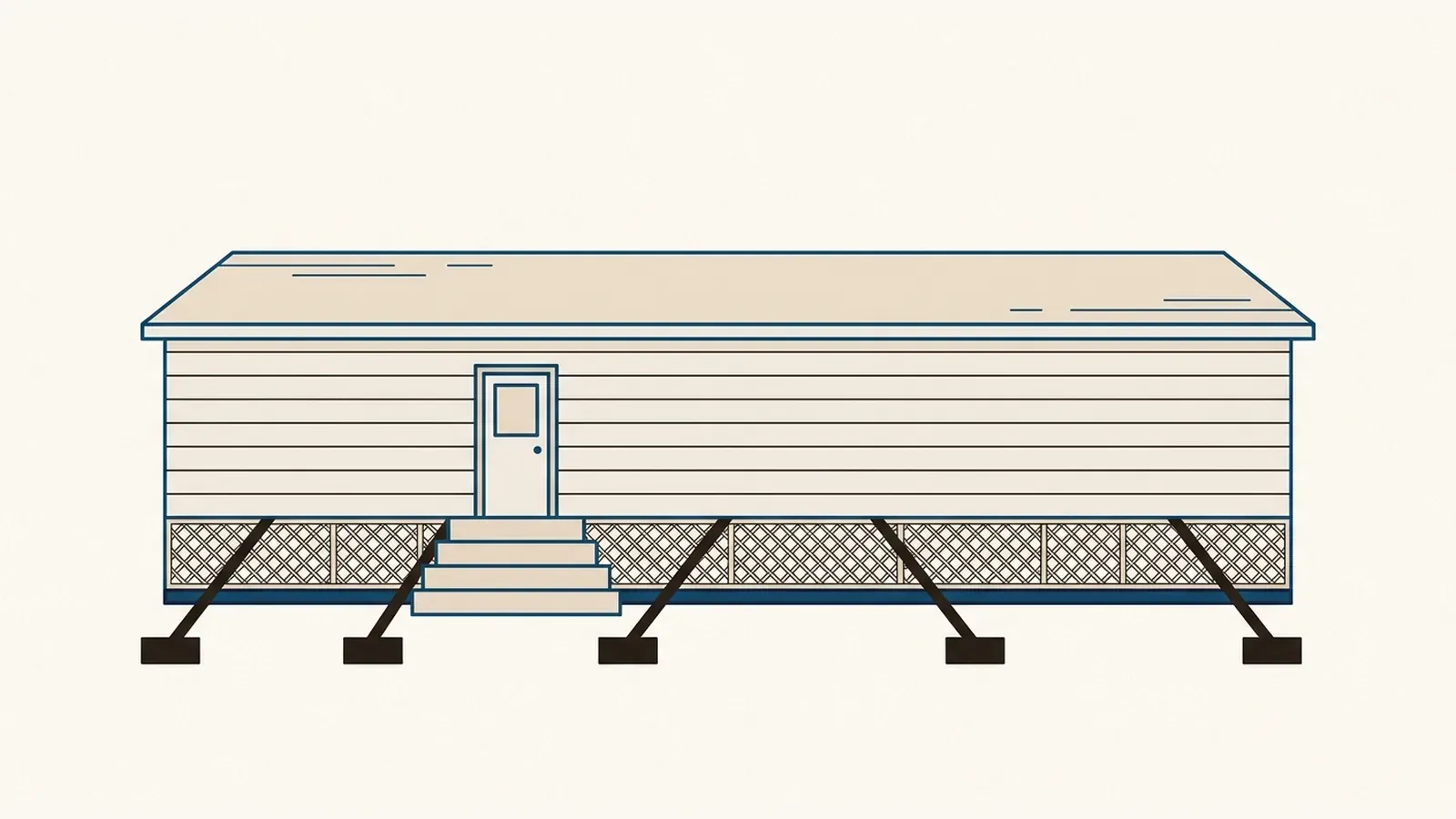
A manufactured home is a house. Most of an inspection on one looks like an inspection on any other house. The roof, the electrical panel, the water heater, the windows, the floors, the heat and air equipment: all of it gets looked at the same way. Everything in what a home inspector actually checks applies here.
What's different is a short list of systems a site-built house doesn't have. They sit underneath, mostly out of sight. That's where the costly surprises live. There's a paperwork side too, because a lender financing a factory-built home usually needs items in the file that a site-built loan never asks for.
Is there a difference between a mobile home and a manufactured home?
Yes. It comes down to when the home was built. The federal building standard for factory-built housing, usually called the HUD Code, took effect in June of 1976. Homes built after that date are manufactured homes, built to that federal standard. Homes built before it are what most people still call mobile homes. A modular home is a third thing. It's built in a factory, but to the same building code as a site-built house, and lenders treat it like one.
In conversation the terms run together, and nobody will correct you at a showing. It matters in two places. Financing: several loan programs won't lend on a home built before the HUD Code took effect. And paperwork: a post-code home carries labels and a data plate that a pre-code home doesn't.
We inspect mobile and manufactured homes across Conway and Central Arkansas. The mobile home inspection page covers what that service includes.
What does an inspector look at that does not exist on a site-built house?
Four things, all of them underneath: the tie-down and anchoring system, the piers and footings carrying the home, the bottom board that closes in the underside of the floor, and the skirting around the perimeter. On a multi-section home there's a fifth. That's the marriage line where the halves meet.
| The part | What we look at | Why it matters |
|---|---|---|
| Tie-downs and ground anchors | Anchors still seated in the soil; straps present, tight and not badly rusted | The wind connection. Straps get cut for access and never put back |
| Piers, footings and shims | Piers plumb and stacked right, footings not sunk, shims still tight | Movement shows up inside as sloping floors and sticking doors |
| Marriage line, multi-section homes | Support under the centerline, the ceiling and floor seam, the gasket between halves | A gap along the centerline is a straight path for water and air |
| Bottom board, the belly wrap | Tears, sagging, water held in the belly, insulation fallen away | A torn belly is how a floor gets wet from underneath and stays wet |
| Skirting and ground cover | Vents, an access panel that opens, grade draining away, ground cover | Sealed with no vents traps moisture; a hole lets animals in to tear the belly |
What goes wrong with tie-downs?
Straps go slack. Anchors work loose in the soil. Somewhere along the way, somebody cuts a strap to get equipment underneath and never puts it back.
A manufactured home is held down by straps running from the steel frame to anchors driven into the ground or fastened to concrete. It's a system, not a part. The anchor, the strap, the connection at the frame, and the soil the anchor sits in all have to work at once. The weakest one sets the result.
Soil is the part people forget. Clay soils swell when wet and shrink when dry, so an auger anchor that was tight the day it went in can be loose several seasons later. Rust is the other one. This hardware lives outdoors at grade, in the splash zone.
Then there are the changes people make. A carport, deck or room addition gets attached to the home. A plumber cuts a strap to get room to work, or the skirting gets replaced and the anchors end up buried behind it. None of that is done in bad faith. It just means anchoring on a lived-in home is worth a look rather than an assumption.
We report what the anchoring looks like on the day of the inspection. That's the limit of it. Whether the system as installed matches the manufacturer's installation manual is an installer or engineer question. If that's what your lender wants, find out early.
What is the bottom board, and why does a tear in it matter?
The bottom board is the membrane stretched across the underside of the floor. A tear in it isn't cosmetic. It's the start of a wet floor.
Installers call it the bottom board, the belly wrap, or just the belly. It does three jobs: it holds the floor insulation up against the floor, it keeps moisture and outside air out of the cavity, and it keeps animals out. When it tears, all three stop. Insulation slumps. The membrane starts holding water instead of shedding it. The floor decking sits right above that, and on many homes it's a pressed wood product that doesn't do well wet.
Tears rarely happen on their own. Usually it's trade work, where somebody opens the belly to reach a line and doesn't patch it afterward. Animals do it too, and so does road damage from the original move. On many homes the supply ducts run through that same cavity, so a tear beside a duct connection means conditioned air blowing into the belly and carrying moisture with it.
Caught early, this is one of the cheaper items on the list. A good installer can patch a tear quickly. The expensive version is the one nobody looked at for several seasons.
Is skirting just cosmetic?
No. Skirting is part of how the underside stays dry. It's also how anyone gets under there to look in the first place.
Done right, it does three things at once: vent openings so the space underneath dries out, an access panel that actually opens, and grade beneath it that slopes away so rain runs off rather than under.
Done wrong, it does the opposite of all three. Sealed tight with no vents, through an Arkansas summer, it turns the space under the home into a humid box right beneath a wood floor. A hole in it lets animals in. Animals are a common cause of a torn bottom board. Set below a grade that slopes toward the home, it puts standing water right where the anchors and the belly are.
If the access panel is screwed shut, painted over, blocked by a deck, or was never installed, the underside can't be inspected. That's a limit. It goes in the report as one rather than getting quietly skipped. If you're the buyer, ask the seller to make the access openable before the inspection date.
What about the roof, plumbing and electrical?
Same systems as any house. There are a few details specific to factory-built construction.
Roof. Older factory-built homes often have low-slope metal roofs meant to be recoated on a schedule. Leaks on those start at seams, fastener heads and roof penetrations rather than mid-panel. Roof-overs, meaning a second roof built over the original, are common. They can be a reasonable repair. They also hide what's underneath, so ask when it was done and by whom. Central Arkansas roofs take a beating no matter what kind of house they sit on.
Crossovers. On a multi-section home, water and drain lines cross between the halves through the belly, and they leak because they're out of sight. The crossover duct carries air from one half to the other. It fails just as quietly. When it comes loose or gets crushed, one end of the home never quite gets comfortable, and the owner assumes that's just how the house is.
Electrical. Many manufactured homes are fed from a separate meter pole rather than a panel on the house, with the main disconnect out at the pole. So that pedestal and its grounding are part of the picture. Old heat tape on exposed supply lines is worth a look too. It's both a freeze risk and an electrical one.
Why do lenders want a specific kind of report on a manufactured home?
Because a loan on a factory-built home has to document things about the home itself that a site-built loan never asks about. The underwriter needs those items in the file before closing.
Requirements vary by program and by lender. Treat this as a list of things to ask about rather than a rule that applies to your file.
The HUD label and the data plate. A manufactured home carries a metal label on the outside of each transportable section and a paper data plate inside, often in a kitchen cabinet, a bedroom closet, or near the electrical panel. The plate lists the manufacturer, the serial number, the date of manufacture, and the Wind Zone, Roof Load Zone and Thermal Zone the home was built for. Underwriters and appraisers commonly want these documented. On an older home the plate is often painted over, papered over, or simply gone. That's a paperwork problem before it's an inspection problem.
The foundation. Many programs require the home to sit on a permanent foundation and to be taxed as real property rather than titled the way a vehicle is. Confirming that the foundation meets the federal permanent-foundation standard comes as an engineer's document, not a home inspection report. A home inspector doesn't issue it. If your lender's checklist asks for one, you need an engineer. Better to learn that three weeks before closing than three days before.
Whether the home has been moved, and what came off it. Some programs ask whether the home was moved from its original installation site, and whether the hitch, axles and wheels were removed. Those are questions about history, answered by the seller, the title work, and the evidence on site.
So get your lender's checklist in writing before the inspection is scheduled. Ask David when you book, so the scope of your inspection is clear up front. If an item belongs to an engineer, an appraiser or the title company, you'll know in week one instead of the last week.
What is not part of a mobile home inspection?
The same boundaries that apply to every other inspection here, plus two documents that aren't an inspector's to produce: the engineer's foundation report and the appraisal. Neither one is an inspection. Neither is something an inspection replaces.
We don't offer sewer line scoping, radon testing, pool or spa inspections, or well or septic inspections. That's as true on a manufactured home as on a site-built one. On a rural property a well or septic system is a real possibility, so line up a specialist early. The services page lists what is and isn't included.
Then there's the scope of the thing itself. An inspection reports the observed condition of the home on the day of the inspection. It isn't a warranty or a guarantee. It isn't a grade. It gives you the facts, in plain language, so you can decide with confidence.
If the seller agrees to fix items that turn up and you want them checked before closing, that's a re-inspection. Re-inspections are a flat $200. This post walks through when one is worth it.
How do you get a mobile home inspection scheduled?
Call or text David at (501) 499-7154, or send the details through the contact form.
Mobile home inspections are a custom quote. The residential schedule is published separately.
Residential inspections come back as a photo-rich report within 48 hours. For commercial, new construction, mobile and outbuilding inspections, David will confirm the turnaround when you book.
Home base is Conway. We cover 15 Central Arkansas counties and 143 cities and towns, from Little Rock to the smallest of them. Properties beyond a 2-hour drive are welcome with a custom quote, and the where we work page lists the counties. We're open Monday through Friday, 8 AM to 5 PM. Every inspection is done by a licensed Arkansas home inspector. You talk to David, who inspects your home.
Have two things ready when you call: whether the home is single-section or multi-section, and whether the underside is reachable. If the skirting has no access panel, say so, because that changes what can be reported.
If you're under contract on a mobile or manufactured home in Central Arkansas, call or text David at (501) 499-7154 or send the details through the contact form. Selling one instead? A pre-listing inspection finds these items before a buyer's inspector does. Agents placing an inspection for a client, start here.
Ready to book an inspection?
Call or text David at (501) 499-7154, or send a request and he will get back to you.